Karate Belts Explained: What the Colours Mean, and Why No Order Is Universal
· Pavika Editorial
Also available in: हिन्दी

New students and parents often ask the same thing: which colour comes after which? The short answer is that there is no single karate belt order. Here is what the ranks mean, and what does and doesn’t carry over from one school to another.
Kyu and dan: the basic idea
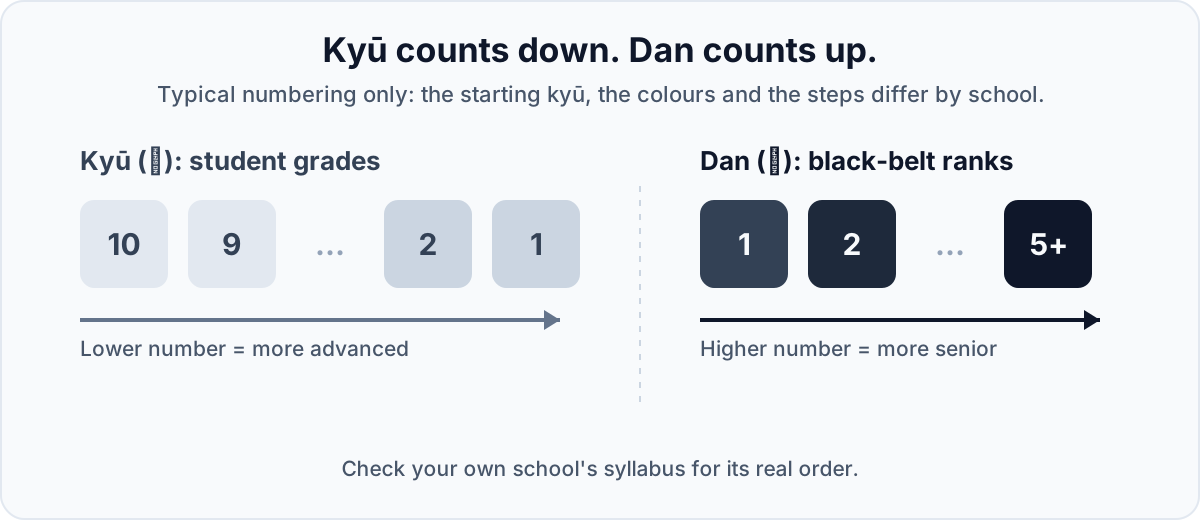
Japanese martial arts split rank into two groups. Kyū (級) covers the lower grades, and dan (段) covers the higher ones. The word dan literally means “step” or “stage”.
Kyu grades count down. A beginner might start around 10th kyu and move toward 1st kyu, so a lower number means a more advanced student. The lowest grade also depends on the organisation: the United States Judo Federation, for example, starts adults at 7th kyu and juniors at 12th.
The first dan, called shodan, is the black-belt level. After that, dan grades count up. People below shodan are called mudansha (“those without rank”), and dan holders are yūdansha.
Where did this come from? The sources point to judo’s founder, Kanō Jigorō. He began awarding dan ranks in 1883 and introduced the modern white uniform, with white and black belts, in 1907. Gichin Funakoshi adopted the dan system for karate in 1924, and other Okinawan teachers later followed.
Colours differ by school and style
Many people picture a fixed rainbow ladder. In reality, no standard colour-to-rank mapping exists. Broadly, white is often the lowest rank and brown the highest kyu, with darker shades signalling more experience. Beyond that, the details are up to each school.
- Some arts keep every kyu grade in white. Others use tags or stripes to mark progress.
- Aikido schools mostly use white for kyu and black for dan, though a few use colours.
- The colour sequence itself varies. For example, the Kyū article explains that with overdyeing, belts darken in a sequence such as yellow, orange, green, blue, brown.
Colours above black vary too. Judo allows red-and-white or solid red belts at very senior dan levels, depending on the rank. Some Okinawan styles use gold stripes to mark titles such as renshi, kyōshi and hanshi, and since the early 2000s some also use stripes for dan grades above 5th dan. Many arts simply keep the black belt for every dan grade.
One tip follows from all this: don’t compare belts across schools. A green belt in one club may not match a green belt next door, and ranks don’t necessarily translate between arts.
Not every art uses belts
Kendo, iaidō and jōdō use dan ranks but wear no external rank marker, even though the black belt is the symbol most people recognise. Kendo is an interesting case. The Tokyo police started a kyū system for kendo to measure officers’ skill, yet kendo has no belt system today.
The dan idea reaches beyond fighting arts altogether. The game of Go, shogi, tea ceremony, calligraphy and archery (kyūdō) all use it.
How does a grading work, and how long does it take?
In karate, kyu grades focus on stances, balance and coordination, with speed and power added later. Testing is a demonstration before examiners and may include basics, kata, bunkai, self-defence, breaking and sparring. Minimum age and time in grade can affect promotion.
As for the black belt, we can’t give you a number, and the sources don’t either. Requirements differ between styles, organisations and schools. Lower dan grades are earned by exam or competition, while the highest grades usually reward years of experience and contribution.
If someone promises a fixed timeline, treat it as that school’s own rule. Ask your instructor what their grading requires.
Belts are a map of one school’s syllabus, not a universal measure.
Safety note
Grading preparation involves physical technique. Train under a qualified instructor, warm up before every session, and respect your limits. Don’t rush toward the next belt.